docs
How kien/stack works
One installer, three packs, everything driven from Git. Each pack adds a layer on top of the previous one.
Overview
All-In-OnePrometheus · Grafana · Authentik SSO · SeaweedFS S3 · Radar · Argo Rollouts · image-updater · Renovate · app-template · Terraformpaid
Private AIOnyx · Ollama · LiteLLM · OpenClaw · Coderpaid
StarterArgoCD · Traefik · cert-manager · external-dns · Infisical + External Secrets · CloudNativePG · OpenEBS · metrics-serverfree
Your clusterk3s · EKS · GKE · AKS · Scaleway · OVH · minikube (Cilium on k3s / bare metal)you bring
Every component is open source and installed from its upstream Helm chart, at a pinned version. ArgoCD owns all of them, including itself.
GitOps workflow
- You edit stack.yaml or a values file
- git push to your repo
- ArgoCD detects the change
- Cluster converges, drift is reverted
- Single source of truth:
stack.yamlselects the pack, domain, TLS issuer, DNS provider and AI providers. - App of apps: one root
platformApplication generates one Application per component, ordered by sync waves. - Secrets never in Git: stored in Infisical, synced into Kubernetes by External Secrets.
Starter free
- DNS (external-dns)
- Traefik + TLS (cert-manager)
- Your apps
- Postgres (CNPG) · secrets (Infisical)
- Ingress: Traefik, automatic HTTPS (self-signed, Let's Encrypt HTTP-01 or DNS-01).
- Data: CloudNativePG operator for HA Postgres with backups.
- Needs: 2 vCPU / 6 GB RAM (8 GB recommended). No load balancer at home? With Cilium, set
ingress.ciliumLBto a free IP range of your LAN: Traefik gets a real LoadBalancer IP announced in L2, no MetalLB needed. - Optional Cilium:
optional.cilium: trueinstalls Cilium first (eBPF CNI, replaces kube-proxy) on a bare cluster, e.g. k3s without flannel. - No domain? Leave
domainempty: you get<ip>.sslip.ioaddresses with self-signed certificates.
Private AI paid
- User asks in Onyx
- Onyx searches your indexed docs
- LiteLLM routes the prompt
- Ollama (local) or Anthropic / Gemini / Bedrock
- Onyx: chat + RAG over your documents (OpenSearch index, connectors).
- LiteLLM: one OpenAI-compatible gateway for local and cloud models.
- OpenClaw: AI agent wired to LiteLLM. Coder: cloud dev environments.
- Data stays home with Ollama; external providers are opt-in, under your own account.
- Needs: 8 vCPU / 24 GB RAM, NVIDIA GPU recommended.
All-In-One paid
- Renovate / image-updater bump a version
- Commit in Git
- ArgoCD syncs
- Argo Rollouts canary
- Observability: Prometheus, Grafana dashboards and alerts for every component.
- SSO: Authentik (OIDC) for your platform tools.
- app-template: one Helm chart to deploy any app from a values file (Deployment, StatefulSet, CronJob, Service, Ingress + TLS, secrets), with a ready-to-copy ArgoCD example.
- S3 storage: SeaweedFS, S3-compatible buckets for backups (CNPG), artifacts and apps.
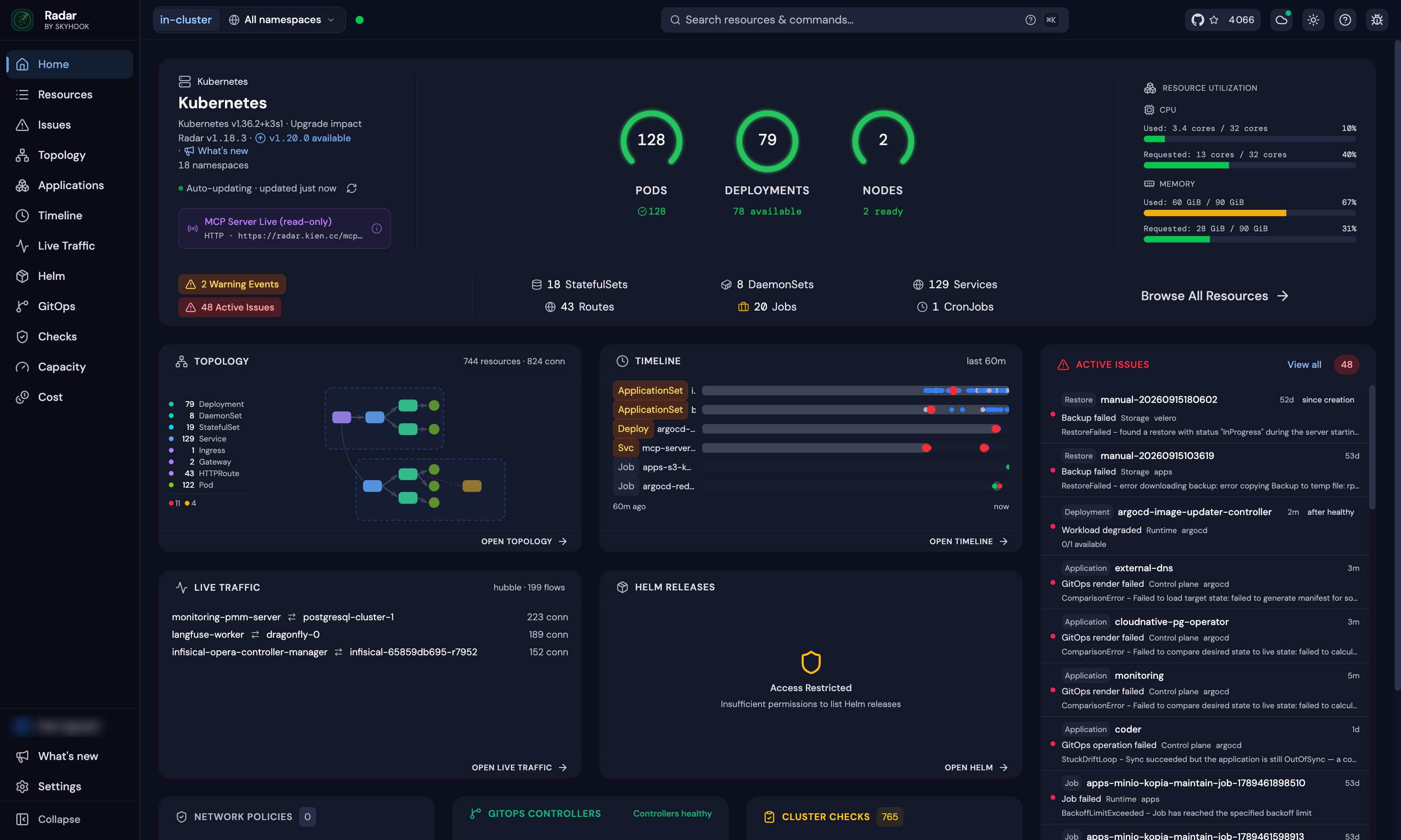
- Radar: Kubernetes UI with resources, topology, timeline, Helm and GitOps (ArgoCD) views. Read-only by default, private until you put SSO in front.
- Terraform: creates an EKS cluster (VPC on 3 AZs, gp3) and runs the installer.
Install
cp stack.example.yaml stack.yaml   # pack, domain, providers
./install.sh doctor                # checks tools, cluster, resources
./install.sh install --pack starter
The installer bootstraps ArgoCD with Helm, registers your Git repo, then hands everything over to ArgoCD and waits until all apps are Healthy.
Updates
- Releases are versioned (
v1.2.0); component versions are pinned in one file. - To upgrade: pull the new tag into your repo; ArgoCD applies it. The changelog flags breaking changes.
Questions? See the packs or order.